



Hamsa Hand Regional Traditions and Jewelry Meanings
The Hamsa is a hand-shaped motif found on jewelry and other objects in parts of North Africa and the Middle East. It has been used in more than one community, often in connection with beliefs about the evil eye. Yet a hand is not automatically a Hamsa, and a pendant does not have one fixed meaning because it has five fingers. Region, maker, date, materials, and accompanying details change what can be said about it.
This guide examines documented hand amulets from Morocco and Gaza, a beadwork example from historic Palestine, and a Hamsa motif on a Moroccan Jewish Hanukkah lamp. Those objects provide a more reliable starting point than a universal chart assigning separate powers to every color or direction. For modern jewelry, the buyer still needs ordinary information about construction, fit, and care.

The Name and the Hand Motif
Khamsa means “five” in Arabic, and the name points to the hand's five digits. The British Museum uses khamsa and “Hand of Fatima” in its records for hand-shaped amulets from the Middle East and North Africa. The latter name refers to Fatima, the Prophet Muhammad's daughter. Other names and interpretations circulate among Jewish and other communities; a product description should identify the particular context it means rather than treating every name as interchangeable.
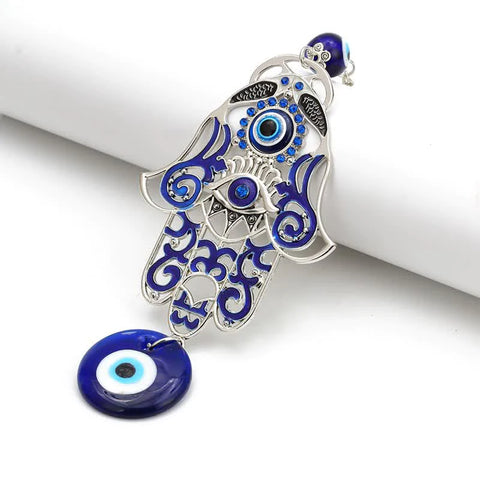
Some hands have a realistic thumb and little finger; others are nearly symmetrical. Some include enamel, glass, metalwork, writing, or additional shapes. The eye often added to a modern Hamsa is not a requirement for every historical example. A maker can combine motifs, but the combination should be described as a design decision unless a source establishes how that particular community read it.
A Moroccan Silver Pendant
The British Museum records a large silver hand pendant made in Morocco around the 1890s. It is approximately thirteen centimeters high and eight centimeters wide. Stamped circles and dots cover the hand. Near the top is a raised roundel with yellow and green enamel, and a red or amber-colored glass element. A smaller cruciform-shaped pendant, also called a khamsa in the museum record, hangs from the roundel and holds a small green glass bead.
This is a useful object study because the detailed construction resists a simplified reading. The museum identifies silver, enamel, glass, and suspension hardware; it does not say that every colored part carries a separate universal spiritual effect. Its curatorial note says hand amulets of this kind may have been used by Muslims or Jews to ward off the “eye of envy.” The word “may” matters: the record does not identify the particular original owner's faith or prove that the pendant prevented harm.
For a modern pendant advertised as “Moroccan Hamsa,” compare its actual form and materials with a named source like this one. An inexpensive cast charm can still be attractive, but it should not be sold as a nineteenth-century silver technique or as an exact replica unless those claims are supported.

A Gaza Hand Amulet
A second British Museum record describes a hand-shaped pendant made in Gaza between about 1900 and the 1930s. It is much smaller, approximately 2.7 centimeters long and two centimeters wide, and uses gilded copper wire and a turquoise bead. The museum classifies it as an amulet against the evil eye or eye of envy. Filigree construction, scale, and the bead make it visibly different from the Moroccan pendant.
Together, the two records show regional variety without requiring a story of one design evolving neatly into the other. Both concern hand-shaped amulets, but they differ in material, size, ornament, and probable wearing experience. A seller who merely writes “ancient Middle Eastern protection hand” leaves out the details that let a reader understand the specific design.
Blue Glass Hands on Cotton Cord
The British Museum also holds an amulet made in historic Palestine from small blue glass beads strung on cotton. Many beads are shaped as stylized hands. Its collection description links these hands with protection against the eye of envy, but it does not assign each bead a color code or a prescribed wrist.
This example expands the idea of what a Hamsa object can be. The hand may be one metal pendant, a small bead repeated along a cord, or a motif on a larger household object. If a bracelet copies this beadwork, the number of beads, cord condition, hole finish, and secure fastening matter as much as the symbol named in the listing.
A Jewish Use in a Moroccan Lamp
The Jewish Museum describes a copper-alloy Hanukkah lamp made in Morocco in the second half of the nineteenth century with a hand or Hamsa motif at the center of its backplate. This is not a wearable amulet. It documents the hand motif within a specific Jewish ritual object and a North African setting.
The lamp matters because it avoids two errors. The Hamsa is not exclusively Muslim, and a Jewish object bearing it should not be relabeled “Hand of Fatima” without explanation. At the same time, one Moroccan lamp does not establish that every Jewish community used the same design or understood it in the same way. The object record supports a narrow, concrete statement, and that is enough.

What an Eye or Fish Adds to a Design
An eye placed in the palm can refer to beliefs about the evil eye, but not every Hamsa contains one. Check whether the eye is made of glass, enamel, engraving, or a separate attached bead. That choice changes both the appearance and the care of the jewelry. A product that combines a Hamsa with a blue eye-shaped disk is combining two recognizable amuletic forms; it should not promise that the pair doubles protection.
Fish, flowers, letters, and geometric borders also appear on contemporary hand designs. Their meanings cannot be read from a universal chart. The Jewish Museum, for example, describes a 2007 marriage contract that includes fish, floral patterns, and a Hamsa among its imagery. That is evidence for one artist's composition, not proof that a fish inside every hand means fertility or that every flower means prosperity.
When a listing claims a specific meaning for an added motif, ask who made the object, which tradition informs it, and what source supports the interpretation. If no such source exists, a plain design description leaves the wearer free to attach a personal meaning without inventing history.
Claims About Other Religions Need Sources
The former version of this guide described the Hamsa as a standard Buddhist protector paired with the Dharma wheel and made a broad Christian claim about the five wounds of Christ. The museum objects used here do not support either statement. Buddhist hand gestures and Christian imagery of wounds have their own histories; visual or numerical resemblance does not establish that they are Hamsa traditions.
This does not rule out a documented individual object that combines these forms. It means that each combination needs its own maker, region, date, and community source. Do not present a modern mixed-symbol pendant as a universal emblem shared by all faiths. Buyers deserve to know whether they are seeing historical iconography or a contemporary studio design.
Direction and Color Are Not Universal Rules
Online charts often say fingers up means protection and fingers down means abundance. The four objects above do not establish that as a rule across Jewish and Muslim communities. A pendant's orientation may also change when it hangs, is photographed, or is worn as a reversible charm. If direction matters in a particular family or local practice, describe that practice by name rather than stating it for everyone.
The same restraint applies to color and material. Silver, turquoise, blue glass, green enamel, and copper appear in the documented objects, but their presence does not validate a fixed “silver equals purity, green equals wealth” system. Material has verifiable properties such as weight, tarnish, fragility, and maintenance. A seller's symbolic color story should be labeled as its own interpretation unless tied to a documented tradition.
Choosing and Gifting Hamsa Jewelry
Start with the person and the piece. Ask whether the recipient has a connection with a community that uses the symbol or simply likes the design, and whether they are comfortable wearing an amulet associated with a living belief. Do not assume that a person must welcome it because it is marketed as positive. A short note can explain the source of the design and why it was chosen without asserting that it will protect them.
Then check the jewelry itself: metal type and fineness, plating, dimensions, weight, sharp edges between the fingers, how securely the loop is soldered, whether enamel or glass is chipped, and whether any bead can detach. For a bracelet, measure the wrist and inspect elastic or cord. For a pendant, check chain length and the way the hand hangs. For children, avoid loose small parts and long cords.
If the product is described as antique or handmade, request evidence of age or process. If it says “Moroccan,” “Palestinian,” or another origin, establish whether that names the place of manufacture, the source motif, or the seller's aesthetic inspiration. Those are different claims. A museum link can document a reference design but cannot authenticate an unrelated retail item.
Care Based on Construction
Wipe plain metal with a soft cloth after wear. Keep plated finishes, enamel, glued settings, and glass away from abrasive cleaners and prolonged soaking. Silver can tarnish; use care appropriate to the finish and any stones rather than polishing every recess aggressively. Inspect the suspension loop, fine wire, and cord regularly. An amulet's symbolic role does not keep a weak joint from breaking.
Store the piece separately so projecting fingers and attached beads do not catch on other jewelry. If a glass insert chips or a small bead loosens, stop wearing it until a qualified jeweler checks the setting. The physical care rules depend on the actual materials, not a claimed spiritual property.
Conclusion
The Hamsa is best described through a named community and a specific object, not a universal list of powers. The Moroccan silver pendant, Gaza filigree hand, Palestinian glass-bead amulet, and Moroccan Jewish lamp show shared hand imagery alongside real differences in form and use. For a new purchase, verify provenance and construction, and present protection as a documented belief rather than a guaranteed result.
Factual References
- British Museum, Moroccan silver khamsa, museum number 2014,6009.1: https://www.britishmuseum.org/collection/object/W_2014-6009-1
- British Museum, Gaza hand amulet, museum number As1966,01.440: https://www.britishmuseum.org/collection/object/W_As1966-01-440
- British Museum, glass hand-bead amulet, museum number As1966,01.846: https://www.britishmuseum.org/collection/object/W_As1966-01-846
- The Jewish Museum, Hanukkah lamps including a Moroccan lamp with Hamsa motif: https://thejewishmuseum.org/press/accumulations-hanukkah-lamps-release/
- The Jewish Museum, marriage contracts with fish floral patterns and Hamsa: https://thejewishmuseum.org/press/jts-ketubbot-release/
Frequently Asked Questions
Is the Hamsa only a Muslim symbol?
No. The British Museum notes possible use of its hand amulets by Muslims or Jews, and the Jewish Museum documents a Hamsa motif on a Moroccan Hanukkah lamp. A specific piece still needs its own context.
Does every Hamsa have an eye in the palm?
No. Historical and modern hand motifs vary. An added eye can refer to evil-eye beliefs, but a seller should identify the actual design and source instead of treating it as a required feature.
Do fingers up and fingers down have fixed meanings?
Not across all regions and communities. Ask for a source tied to the particular tradition or maker. A generic orientation chart is not enough.